
Lost circulation material Calcium Carbonate (LCM)
Application-engineered calcium carbonate for selected oil & gas drilling, lost circulation, bridging and drilling-fluid requirements — developed around particle-size, acid-solubility and application-specific specifications.
RMM focuses on engineering the material around the requirement, rather than treating calcium carbonate as a one-size-fits-all powder.
Engineering
Engineering
Engineering
Engineering the Material Around the Oil & Gas Drilling Applications
RMM LCM Technology™ represents Rishabhdeo Micro Minerals' application-engineering approach for calcium carbonate intended for selected oil & gas drilling and lost-circulation Applications.
Instead of defining a material only by a generic powder grade, RMM evaluates the customer's application, particle-size requirements, mesh requirements and acid-solubility conditions before identifying a suitable calcium carbonate grade within validated manufacturing capability.
The objective is to provide a technically defined material around the customer's requirement while maintaining controlled and repeatable manufacturing.
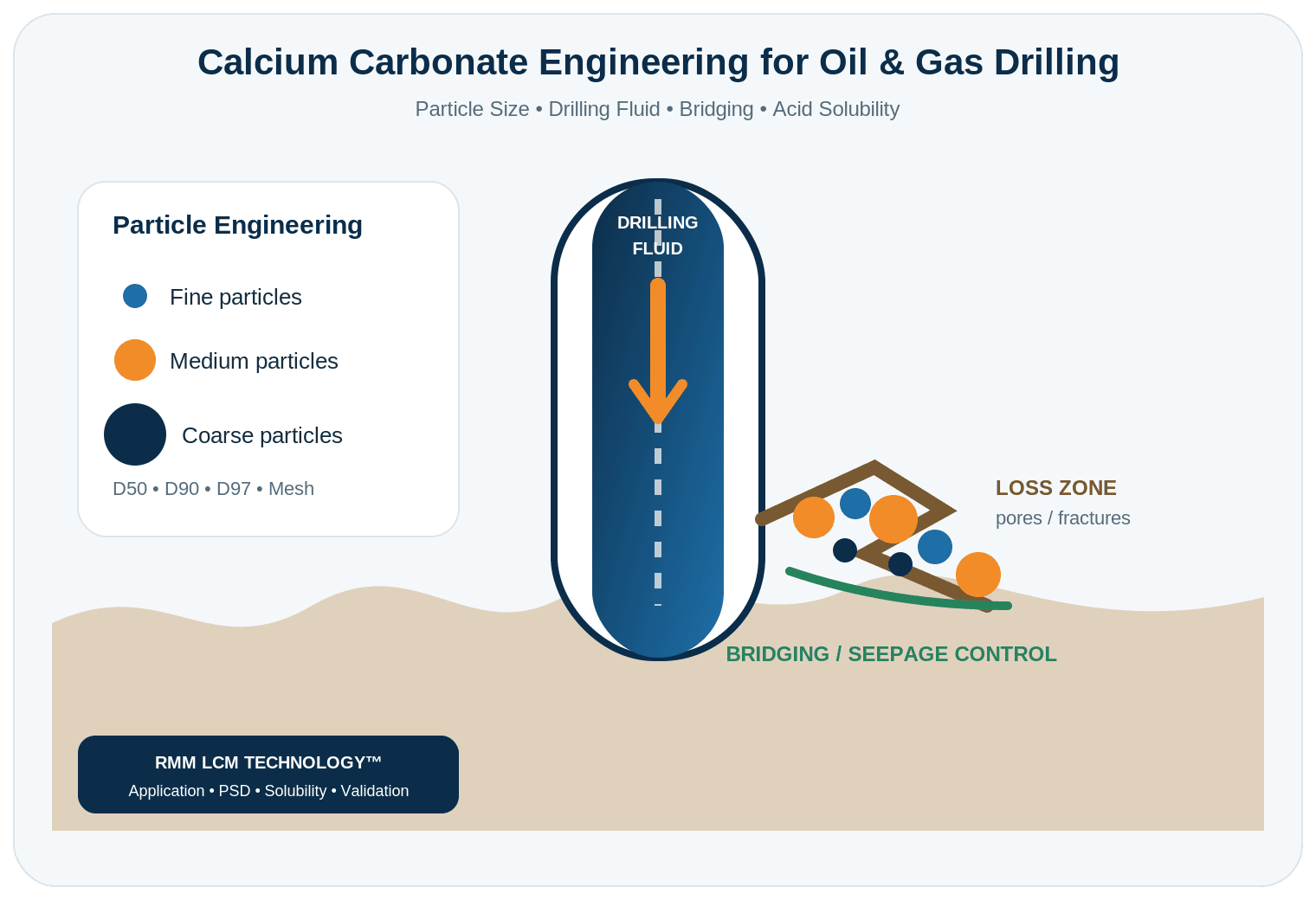
Four Engineering Layers Behind the RMM Approach
The public technology framework explains the engineering philosophy without disclosing proprietary formulation parameters.
Application Analysis
Understand the intended drilling, bridging or lost-circulation application and the customer's technical requirements.
Particle Engineering
Evaluate particle-size distribution, D-values and mesh-based requirements according to the intended application.
Solubility Engineering
Consider acid-solubility requirements together with defined test conditions rather than relying on an undefined percentage.
Performance Validation
Laboratory evaluation and customer-side trials help confirm suitability before finalizing an application-specific grade.
From Requirement to Validated Grade
A structured development pathway helps connect the drilling requirement with an appropriate calcium carbonate specification.
Define Application
Understand the drilling-fluid system, loss condition and intended use.
Define PSD
Establish D50, D90, D97 and/or mesh requirements.
Select Grade
Evaluate fine, medium, coarse or customer-specific calcium carbonate options.
Trial & Validate
Confirm technical suitability through appropriate laboratory and customer-side evaluation.
PSD Is More Than One Number
RMM evaluates the particle-size distribution as a complete technical requirement. D50, D90, D97 and mesh specifications describe different aspects of the material and should not be treated as interchangeable.
Exact grade specifications are established according to customer requirements and validated manufacturing capability.
Connecting Technical Parameters to the Application
RMM's public framework focuses on the relationship between specification and application. Internal formulation and decision parameters remain proprietary.
Evaluate the distribution rather than relying on a single particle-size value.
Passing and retention requirements should be clearly defined together with the applicable mesh standard.
Solubility requirements should be associated with defined test conditions and an agreed laboratory method.
Final suitability depends on the drilling-fluid system, application conditions and customer validation.
RMM Proprietary Formulation Protection
The public technology framework describes the engineering approach, not the proprietary formulation. Specific blend ratios, formulation parameters, internal acceptance criteria and process conditions are developed and controlled internally according to customer and application requirements.
Where the Technology Can Be Evaluated
Application suitability should always be confirmed against the drilling-fluid system and customer technical requirements.
Share Your LCM Requirement
Provide your application and technical requirements. Our team will review them and respond with relevant calcium carbonate information.
Request Technical Details
Share your requirement below. Our technical team will review the application and respond with relevant product information.
Don't Specify Only the Powder. Specify the Application.
Share your D50, D90, D97, mesh, acid-solubility and application requirements with RMM for a technical discussion.