
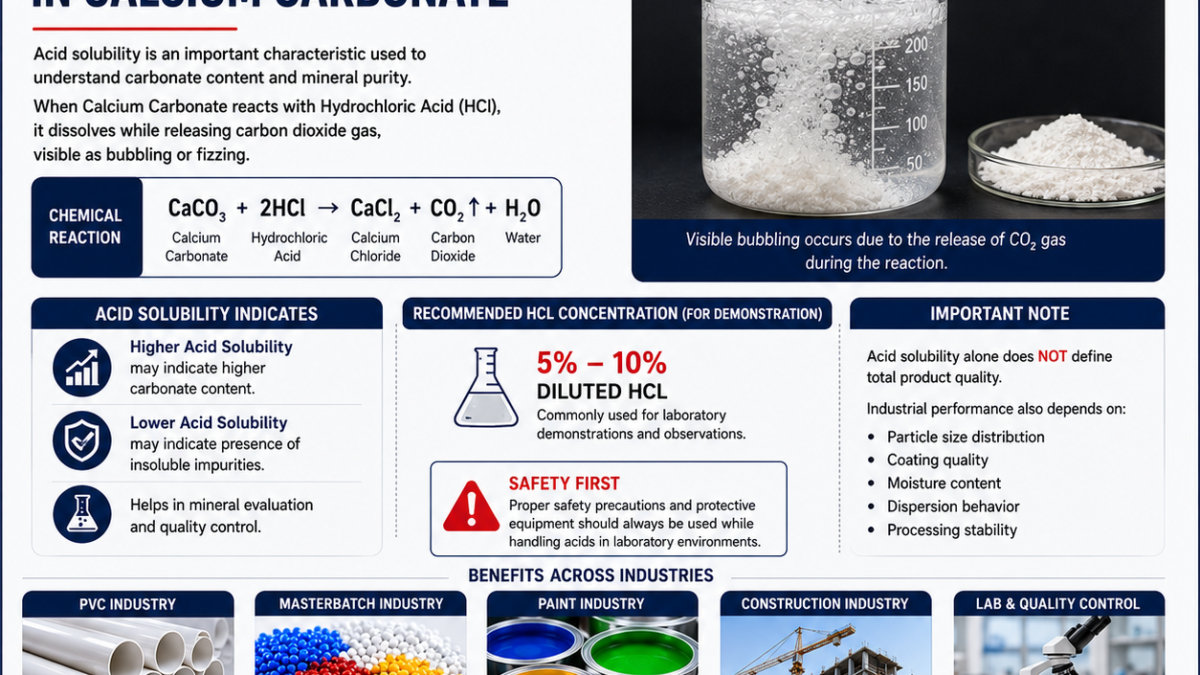
Calcium Carbonate (CaCO₃) is one of the most widely used industrial minerals across the world. It plays a major role in industries such as PVC, masterbatch, paints, plastics, paper, rubber, construction materials, and polymers. Due to its versatility, cost efficiency, and functional properties, calcium carbonate has become an essential raw material for modern manufacturing.
Among the various quality parameters used to evaluate calcium carbonate, acid solubility is considered an important characteristic in mineral processing and industrial applications.
Acid solubility helps in understanding carbonate behavior, mineral composition, and the presence of insoluble impurities. It is commonly associated with the reaction between calcium carbonate and Hydrochloric Acid (HCL), where visible bubbling or fizzing occurs due to the release of carbon dioxide gas.
In this article, we will understand:
- What acid solubility means
- How calcium carbonate reacts with HCL
- Why acid solubility matters
- Industrial applications and benefits
- Factors affecting mineral performance
- The importance of quality consistency in industrial minerals
What is Acid Solubility?
Acid solubility refers to the ability of a material to dissolve or react in an acidic environment.
For calcium carbonate minerals, acid solubility is commonly evaluated using Hydrochloric Acid (HCL). When calcium carbonate comes into contact with acid, it reacts chemically and dissolves while releasing carbon dioxide gas.
The reaction can be represented as:
CaCO₃ + 2HCl → CaCl₂ + CO₂ + H₂O
Where:
- CaCO₃ = Calcium Carbonate
- HCl = Hydrochloric Acid
- CaCl₂ = Calcium Chloride
- CO₂ = Carbon Dioxide Gas
- H₂O = Water
The visible bubbling or fizzing during this reaction occurs because carbon dioxide gas is released.
This reaction is widely recognized in laboratories, geology, mineral testing, and industrial quality evaluation.
Why Does Calcium Carbonate React with HCL?
Calcium carbonate is a carbonate mineral. Carbonates naturally react with acids because the carbonate ions break down in acidic conditions.
When Hydrochloric Acid is added:
- The calcium carbonate starts dissolving
- Carbon dioxide gas is released
- Calcium chloride and water are formed
This reaction is often used as a simple demonstration for identifying carbonate minerals.
The intensity of the reaction may vary depending on:
- carbonate content
- mineral purity
- particle size
- impurities
- moisture
- coating characteristics
Importance of Acid Solubility in Industrial Minerals
Acid solubility is important because it helps indicate:
- carbonate presence
- mineral behavior
- purity characteristics
- insoluble impurities
Higher acid solubility may suggest:
- higher calcium carbonate presence
- lower non-carbonate impurities
- improved mineral consistency
Lower acid solubility may indicate:
- silica
- clay
- sand
- other insoluble mineral impurities
However, acid solubility alone does not define total product quality.
Industrial performance depends on multiple technical factors that work together
Factors Beyond Acid Solubility
In industrial applications, several other properties are equally important for achieving stable manufacturing performance.
1. Particle Size Distribution
Particle size distribution plays a major role in:
- dispersion
- extrusion stability
- surface finish
- flow behavior
- product consistency
Uniform particle size can improve processing efficiency and reduce manufacturing issues.
2. Coating Quality
In coated calcium carbonate, coating quality significantly affects:
- compatibility with polymers
- dispersion performance
- processing smoothness
- moisture resistance
Stearic coated calcium carbonate is commonly used in PVC and polymer applications because it improves filler dispersion and processing behavior.
3. Moisture Content
Moisture control is extremely important in mineral applications.
Excess moisture may lead to:
- feeding problems
- agglomeration
- poor dispersion
- extrusion instability
- machine downtime
Low and controlled moisture levels help improve manufacturing stability.
4. Purity and Consistency
Consistent mineral composition is essential for:
- stable production
- repeatable product quality
- reduced rejection rates
- reliable industrial performance
Industrial buyers generally prefer materials with consistent specifications rather than inconsistent low-cost alternatives.
Acid Solubility in PVC Industry
The PVC industry is one of the largest consumers of calcium carbonate.
Calcium carbonate is widely used in:
- PVC pipes
- PVC profiles
- fittings
- cable compounds
- flooring
- sheets
In PVC processing, filler consistency directly affects:
- extrusion stability
- surface finish
- dimensional accuracy
- process efficiency
Acid solubility can help indicate carbonate content and mineral quality behavior, which may influence overall processing consistency.
However, performance in PVC applications also depends heavily on:
- particle size distribution
- coating quality
- dispersion characteristics
- bulk density
- moisture control
High-quality calcium carbonate can help manufacturers:
- optimize formulation cost
- improve processing stability
- maintain product consistency
Acid Solubility in Masterbatch Industry
Masterbatch manufacturers use calcium carbonate as a filler and functional additive in various polymer formulations.
In masterbatch applications, consistency is extremely important because poor fillers may create:
- uneven dispersion
- weak mechanical properties
- unstable processing
- increased rejection
Acid solubility helps provide an indication of carbonate behavior, while other technical factors influence actual processing performance.
Properly processed calcium carbonate can support:
- smooth feeding
- better dispersion
- stable extrusion
- cost optimization